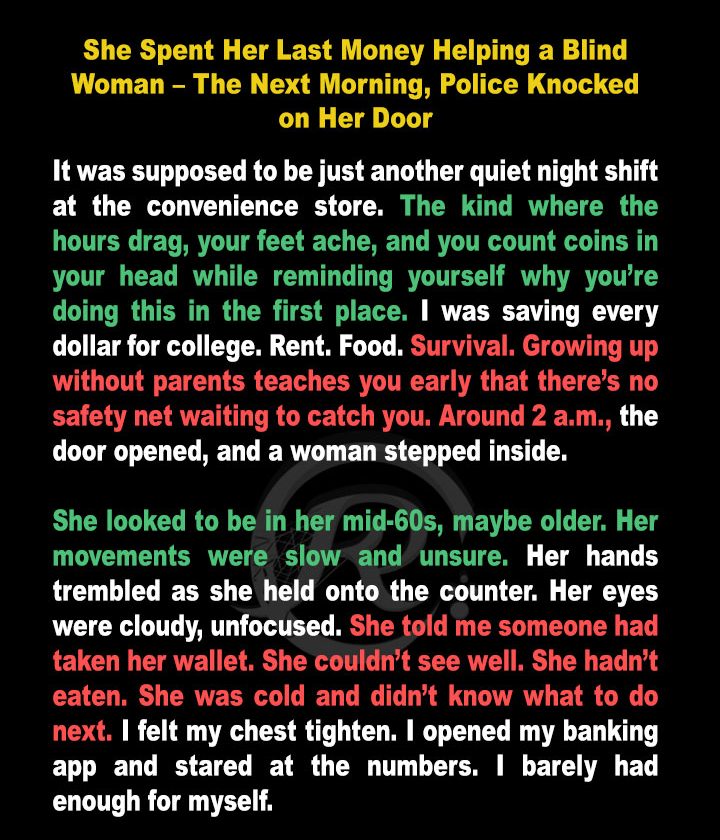
I thought losing my job was rock bottom. But then two officers showed up at my door, asking about the blind woman I helped the night before — and what they said next completely turned my world upside down.
I was 22, broke, and living in a one-bedroom apartment above a noisy laundromat. The walls were thin, the heat barely worked, and my upstairs neighbor seemed to think 3 a.m. was the perfect time to practice his drumming skills.
I worked the night shift at a small convenience store on the edge of town. Not because I liked the hours, but because it paid a little more.
Every cent mattered.
I had no parents, no family, and no safety net. It was just me and a savings account labeled “College.” That was the plan. That was my ticket out.
I didn’t party. I didn’t take vacations. I counted pennies and clipped coupons. Some days, I lived off instant noodles and coffee from vending machines. But I kept going. Because someday all this scraping by was supposed to mean something.
That night was colder than usual.
The kind of cold that cuts through your coat and settles in your bones. I remember it clearly because the heater at the store was busted again, and I was wrapped in two sweaters, rubbing my hands together behind the counter, trying to stay warm.
It was close to 2 a.m. when the door creaked open.
The little bell above it jingled, and I looked up, expecting another half-drunk college kid or a delivery guy picking up snacks.
Instead, a frail elderly woman stepped inside, moving slowly, carefully.
She wore a long beige coat and mismatched gloves. Her gray hair was tucked under a knitted hat, and her eyes were distant — unfocused, cloudy.
She reached out, her fingers searching until they brushed the edge of the counter.
“I’m blind,” she said softly. Her voice shook as much as her hands. “Someone just stole my wallet.”
I blinked, unsure if I’d heard her right.
“What?” I stepped around the counter. “Are you okay? Are you hurt?”
She shook her head.
“No. Just… tired. Hungry. And cold.”
I could see it on her face — she hadn’t eaten. Maybe not all day. Her cheeks were hollow, and her lips were pale.
“What’s your name?” I asked.
“Catherine,” she said. “I was on my way home, but I must’ve dropped my wallet, or someone took it. I can’t find it. I didn’t know where else to go.”
I glanced at the tiny food aisle behind her. “Have you had anything to eat tonight?”
She gave me a weak smile. “Not yet. I was hoping to grab a few things. Maybe some soup.”
I looked at the register, then at her.
I had about $32 in my bank account. That was supposed to last me the whole week. Rent was coming up. I needed that money.
Every part of me screamed not to do it.
But I couldn’t let her leave like that.
“Okay,” I said, clearing my throat. “Let’s get you something.”
I walked her down the aisle, talking her through the shelves.
“There’s canned chicken noodle soup, vegetable, and tomato. Which one do you like?”
“Chicken noodle,” she said with a little smile. “That was my late husband’s favorite.”
I added two cans to the basket.
“Do you have bread?” she asked.
“Yeah. Got some rolls here.”
“And maybe tea?”
“Of course,” I said, grabbing a box. “Let’s get you some tea.”
By the time we got to the counter, I’d added a few more things. Crackers. A warm bottle of juice. An instant oatmeal pack.
I checked my balance again. My stomach sank. Helping her meant losing almost everything I had.
But I did it anyway.
I paid for it all and bagged it up.
Catherine was quiet for a moment.
Then her lip trembled.
“Thank you, sweetheart. I don’t know what I would’ve done.”
“Don’t worry about it.” I tried to smile. “Let me walk you home, okay?”
“You’ve already done so much.”
“It’s no trouble,” I said. “I’ll feel better knowing you got home safe.”
So I locked up the store, grabbed my coat, and held her arm gently as we stepped outside. The streets were nearly empty except for the occasional sound of a passing car. She lived four blocks down in an old apartment building with faded bricks and a flickering porch light.
We walked slowly.
Her steps were careful; her trust in me was total.
When we reached her building, she turned to me.
“Thank you, Anna. You were a blessing tonight.”
Her voice broke on that last word.
“Get some rest, Catherine,” I said gently. “And stay warm.”
I walked back in the cold, my hands shoved deep in my pockets, thinking about how quickly one moment can change everything.
When I returned to the store around 4 a.m., I cleaned up, restocked a few shelves, and waited until the next shift arrived.
My manager, Steve, came in at 6.
He took one look at the closed register and the missing hours and didn’t even let me explain.
“You left the store unattended,” he snapped. “That’s an automatic termination.”
“I was helping someone,” I said, trying to stay calm. “She was blind. She was lost and freezing.”
“You should’ve called the cops or waited till morning,” he said coldly. “You know the rules.”
He handed me my final paycheck and walked away.
I went home and collapsed on my bed, still in my work clothes. I didn’t even take off my shoes.
I cried until I fell asleep.
Around noon, there was a knock on my door.
I dragged myself up, hair a mess, eyes swollen. When I opened it, two uniformed police officers stood outside.
My heart jumped straight into my throat.
“Are you the cashier who helped Catherine last night?” one of them asked.
“Yes,” I said slowly, my hands starting to shake. “Did something happen?”
The officer exchanged a look with his partner.
Then he said, “You need to come with us.”
“But I don’t understand. Did something happen?”
My voice shook. My stomach had already twisted into a knot, and now it felt like the floor might give out under me.
One of the officers, a tall man with kind eyes and a worn badge, gave me a gentle look.
“We’d like you to come with us,” he said quietly. “Do you have an hour?”
I hesitated. My hands were still trembling a little, and I hadn’t even changed out of my hoodie from the night before. But I nodded.
“Yeah… yeah, I guess.”
The car ride was quiet.
I stared out the window, trying to figure out whether I was in trouble or not. Were they just being polite? Was this a weird legal issue with the store? I’d already been fired.
Was there more?
They didn’t say much. Just a few directions and a bit of small talk. One of them, Officer Jenkins, I think, asked me if I liked tea. I said I usually stick to cheap coffee.
Eventually, we pulled into a quiet neighborhood on the east side of town. The houses here were older, but well cared for. Neatly trimmed lawns. Wind chimes. A cat napping on a porch swing. It didn’t look like the kind of place where things went wrong.
They led me up a little brick walkway and knocked on the door of a white house with navy-blue shutters.
A few seconds later, it opened.
Catherine stood there.
She looked different in the daylight. Softer somehow. Her silver-gray hair had been brushed neatly, and she wore a thick blue sweater over a long skirt. She didn’t look frail this time. She looked calm. Peaceful.
She smiled the second she heard my voice.
“Anna?” she said, taking a careful step forward.
“Hi, Catherine,” I said, still confused. “Are you okay?”
“Oh, sweetheart,” she said, reaching out to touch my hand. “Come in. Come sit down.”
As I stepped through the door, something struck me. This wasn’t the same place I’d walked her to last night.
Not even close.
Before I could ask, Catherine seemed to know what I was thinking.
“This is my real home, dear,” she said gently. “Last night, you brought me to Maggie’s building — she’s an old friend. I stay with her sometimes when I’m feeling a little too lonely. She lives closer to the bus stop.”
The officers motioned for me to go inside, and I followed her through a cozy little living room. Floral curtains framed the windows, and the place smelled like cinnamon and old books. The warmth inside wrapped around me, a sharp contrast to the cold, drafty air of my apartment that hadn’t properly heated in weeks.
Catherine guided me to a small kitchen table already set with mismatched cups and a teapot.
There was even a pie on the counter, golden brown, still warm.
“I made this for you,” she said. “Sit, sit.”
I sat. So did the officers.
She poured the tea carefully, with steady hands, then passed me a cup.
“Try the apple pie,” she said with a smile. “It’s a little early for dessert, but I figured this was a special occasion.”
I took a bite just to be polite. But it was good. Really good.
“Catherine,” I said slowly, “I’m sorry, I’m just… I’m kind of confused about what’s going on.”
She nodded, setting her cup down.
Her fingers folded gently in her lap.
“I wanted you to meet these two,” she said. “Officer Jenkins and Officer Ramirez. They’re like sons to me.”
The younger officer, Ramirez, gave her a fond smile.
“We visit Catherine every morning,” he said. “Ever since her son passed.”
I looked at her. “Your son?”
She nodded again, and her expression shifted, becoming tender and proud all at once.
“He was a police officer. Died in the line of duty eight years ago,” she said. “After he passed away, the department made sure I was never alone. These two stop by every day. Check on me. Share coffee. And help with errands. They’ve become family.”
I blinked, unsure what to say.
Catherine turned toward them and said, “I told them what happened last night. About the young woman who helped me when no one else would. About how you bought me food when you barely had anything for yourself. About how you walked me home in the cold, step by step.”
I felt my cheeks flush. I didn’t do it for recognition. I just didn’t want her to be alone.
“I didn’t do much,” I said quietly. “I just… couldn’t leave you like that.”
“That’s everything,” Officer Jenkins said. “Most people would’ve just looked away. Pretended they didn’t see. You didn’t.”
Catherine smiled again, and I could see tears forming in her eyes.
“I lost my son,” she said softly. “But last night, for the first time in a long while, I felt safe again. Because someone like you still exists.”
I swallowed hard.
Ramirez leaned forward and said, “Anna, we didn’t bring you here to question you. We brought you here because we wanted to thank you. And because we think Catherine could use someone like you more permanently.”
I blinked. “What do you mean?”
He exchanged a glance with Jenkins before saying, “Catherine’s been needing help for a while, like cooking, getting around, and running small errands. Nothing too heavy. But she didn’t want a stranger. After last night, she told us you’re the only one she’d trust.”
Catherine reached for my hand.
“I know it’s sudden,” she said. “But I’d like to hire you. As my caregiver. You’d live here if you want, or come by during the day. I’d pay you, of course. Three times what you were earning at that store.”
My mouth dropped slightly. “Three times?”
She nodded. “You’re kind. You’re responsible. You didn’t just help me; you gave up something to do it. That means more to me than I can say.”
I stared at the cup in my hands, then at her, and then at the two officers watching me with quiet encouragement. It felt like I had stepped into someone else’s life. A better one.
A warmer one.
I thought about my savings account, about college, and about all the times I had to choose between gas and groceries. And suddenly, here was this door, open and waiting.
I looked at Catherine.
“Are you sure?” I asked. “I mean, I’m not trained. I’ve never done anything like this before.”
“You don’t need training to be decent,” she said. “You just need a good heart. And you’ve got that in spades.”
I nodded slowly. “Then… yes. I’d be honored.”
Catherine beamed. The officers smiled.
She poured more tea.
We sat at that table for another hour, talking about everything and nothing: her late husband, my plans for school, and what kind of cookies she liked to bake. And for the first time in a long while, I felt like I wasn’t just surviving. I felt like I belonged.
That night, I moved into the spare room down the hall from hers. She insisted that I decorate it however I liked. Said the old curtains were hideous, anyway.
A week later, she helped me enroll in night classes.
She even came to my first college orientation. She held my hand like a proud grandma and whispered, “You’re doing it,” as I got my student ID.
Sometimes, kindness costs you everything.
And sometimes, it gives you more than you ever imagined.
But here’s the real question: when doing the right thing costs you everything — do you regret it, or wait to see if the world has something better in store?