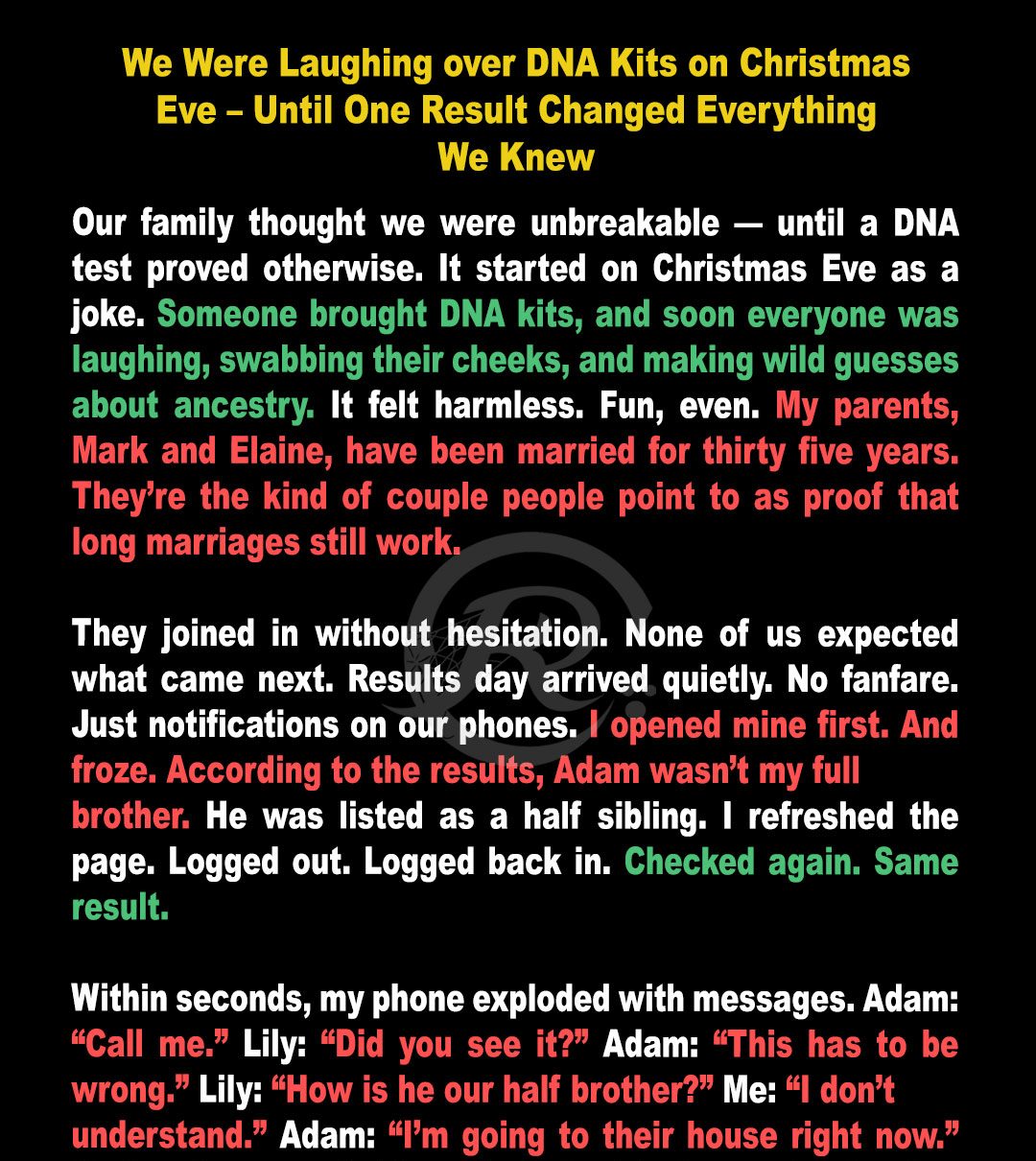
We took DNA tests on Christmas Eve because we thought it would be funny. Instead, one result exposed a secret my parents had kept for over three decades. What followed was anger, silence, and a question that forced my brother to decide what really makes a family.
I always thought the biggest fight we’d ever have at Christmas would be over the last roast potato. Maybe someone would knock over the gravy boat or complain about the gift budget. But I never imagined we’d end up questioning everything we thought we knew about our own family.
It started as a joke, just a silly and harmless one.
My cousin Rachel showed up on Christmas Eve with a grocery bag full of DNA kits.
“Early gifts!” she announced, dumping them onto the coffee table like she was Oprah. “Everyone gets one!”
I laughed as I picked up a box. “Rachel, what is this?”
“Come on, it’ll be fun! You’ll find out you’re five percent Viking or something.”
We were all already a few glasses into the holiday punch.
My dad, Mark, looked over from the couch and raised an eyebrow.
“Is this gonna tell me I’m secretly Italian?”
My mom, Elaine, giggled and nudged him. “After 35 years of marriage, I think I would’ve noticed.”
My brother Adam rolled his eyes, but took one anyway. He was 32, the golden child. The one who got straight As, coached soccer on weekends, and never missed a Sunday dinner. Lily, our youngest sister — she’s 24 — was bouncing with excitement like she thought this was the coolest thing ever.
“I’d better be at least a little exotic,” she grinned, already unsealing the box. “I refuse to be a 100 percent boring white girl.”
I’m Stella, by the way.
I’m 21. The middle kid, the one who always ends up taking the family photos and getting forgotten in the group texts. I swabbed my cheek, sealed the envelope, and tossed it into the pile with everyone else’s.
We laughed, joked about being long-lost royalty, and went back to watching “Elf” while the ham finished baking.
It was one of those perfect Christmas nights. The fireplace was glowing, and everyone had matching pajamas, even Dad. Mom’s sweater had a sequined reindeer that blinked red when she moved.
I thought nothing could ever crack that kind of warmth.
Weeks later, I was sitting at my kitchen table eating leftover pad thai when the group chat started going off like a fire alarm.
Adam: “CALL ME!”
Lily: “DID YOU SEE IT?”
Adam: “This has to be WRONG!”
Lily: “HOW IS HE OUR HALF BROTHER?”
Me: “I don’t understand.”
Adam: “I’m going to their house RIGHT NOW!”
I blinked, barely swallowing my bite before opening my own email.
My stomach sank when I saw the subject line: Your DNA Results Are In!
I clicked it, expecting to see some percentages and maybe a regional map or whatever.
Instead, under Family Matches, I read something mind-boggling.
Full sibling: Lily
Half-sibling: Adam
I stared at it for a full minute. Like I was trying to read it differently. But no, it didn’t change.
My hands were shaking as I typed back.
Me: “Is this real?”
Lily called me seconds later.
“Stel, what does yours say?”
“Same,” I said. “You’re my full sister. Adam’s… half?”
“But that makes no sense,” she said, her voice rising. “We all have the same parents. They’ve been together forever.”
“I know.”
Adam beeped in on the other line.
“Are you going?” I asked her.
“I’m already in the car.”
We didn’t even plan it, but we all ended up pulling into our parents’ driveway at the same time. It was like some weird dramatic movie scene.
Lily slammed her car door shut, marching toward the porch with her phone in hand. Adam looked like he hadn’t slept. His face was pale, his jaw tight. I hadn’t seen him that angry since middle school, when someone stole his bike.
“I printed mine,” Adam muttered, holding up a folder. “This has to be wrong. It has to be.”
I knocked. No answer.
“Mom! Dad!” I called. “It’s us!”
The door creaked open, and there was Dad in his U.S. Navy sweatshirt and slippers.
“What’s going on? Is everything okay?”
“No,” Adam said flatly, brushing past him.
Mom appeared behind him, wiping her hands on a dish towel. “Kids? What happened?”
We all walked into the living room. Adam tossed the folder on the coffee table with a slap.
“Explain this.”
Dad frowned, confused. “What is it?”
“DNA results,” Adam said. “Apparently, I’m not fully related to Stella or Lily.”
Mom’s face froze.
She reached for the folder with trembling fingers.
“What do you mean?” Dad asked, picking up his glasses.
“It says I’m their half-brother,” Adam said, voice low and tight. “You two have always said we’re full siblings. All of us. So, what the hell?”
“No, no,” Mom murmured, scanning the printout.
I pulled out my phone and showed Dad my results.
He stared at them like he was trying to read ancient Greek.
“This… this has to be some kind of mistake.”
“It’s not,” Adam said. “We all did the test. Stella and Lily are full siblings. I’m not. So tell me, what’s going on?”
Lily stood there, arms crossed, her face pale.
“Did someone cheat?” she asked quietly. “Is that what this is?”
Mom dropped onto the couch.
Dad remained standing, stiff.
“Elaine, do you know what this is about?”
She didn’t answer right away. Just kept staring at the papers as they might change.
“Mom?” I said softly.
Her eyes flicked up to us, full of something I couldn’t name.
Regret? Fear?
Or both?
Adam laid his DNA printout on the coffee table and leaned forward.
His voice was tight, but steady.
“According to this, I only share one parent with you two.”
The room froze. No one moved or spoke for several seconds. I could hear the faint hum of the fridge from the kitchen. Outside, a car drove by slowly. It was like the world was carrying on, unaware that ours had just cracked wide open.
I looked at Dad, sitting stiff in the armchair like someone had tied him down. He was 62, graying, still strong in the shoulders from his Navy days, and he looked genuinely confused.
“That’s not possible,” he said. “I’ve been your father from day one, Adam. There is no… there’s no way.”
His voice broke a little on that last word.
Lily, standing near the fireplace, crossed her arms tightly across her chest. “Are you saying the test is wrong?”
Dad didn’t answer. He just stared at the papers, then turned toward Mom.
We all did.
Mom, the one who made us chicken soup when we were sick, who sent us birthday cards with handwritten notes, who made ugly knit scarves every winter and told us to wear them “or freeze,” was pale as a sheet. She looked like the air had gone out of her.
She slowly sank into the couch and stared at her lap.
“I should have told you a long time ago,” she whispered.
Adam blinked. “Told us what?”
She took a shaky breath and looked up, her eyes wet.
“When I was 19,” she began, “I had a relationship. It was fast. Intense. We weren’t careful, and I got pregnant.”
Lily let out a soft gasp. I sat down slowly next to her, my knees suddenly weak.
Mom continued, her voice small.
“I told him. The biological father. He didn’t want anything to do with it. He disappeared. I didn’t know what to do. I thought maybe I’d raise the baby on my own, but I was terrified. I almost broke things off with Mark… but I told him the truth instead.”
She turned toward Dad now, her voice cracking.
“I told him everything. And the next day, he came back with flowers and said, ‘I love you. I want you. I’ll love this baby too.’ He went to every doctor’s appointment. He was there in the delivery room. He signed the birth certificate. He never once treated Adam like anything less than his son.”
Adam was frozen, his jaw tight.
“I was going to tell you,” Mom added, barely audible now. “But every year that passed, it got harder. You were so close, and I… I was a coward. I told myself it didn’t matter.”
Lily’s voice came out sharp. “So, all of us have been living in a lie for 32 years?”
“It wasn’t a lie,” Mom said quickly. “Everything I gave you, all of it, was real. I just—”
“Didn’t think we deserved the truth?” Lily cut in.
Mom flinched. Dad reached for her hand, but she didn’t notice.
I looked at Adam.
His face had gone unreadable.
“So, he never tried to see me?” Adam finally asked, quietly.
Mom shook her head.
“No. He didn’t want you. That’s why I married the man who did.”
There was a long silence after that. Mom’s words hovered in the room, heavy and raw.
Dad reached over and placed his hand on Adam’s.
His fingers were trembling.
“You’re my son,” he said softly. “That never once felt like work or charity. It was the easiest decision I ever made.”
That did it. Tears welled up in Adam’s eyes and started to fall silently. His shoulders stayed square, but I could see how much it hurt. He wiped at his face and nodded slowly.
For a while, no one said anything. We just sat there, sitting with the weight of it all.
Eventually, we left. It wasn’t a dramatic exit, no shouting, no slamming doors. Just a quiet understanding that none of us were ready to process everything in one night.
The next few weeks were strange.
Lily and I started pulling back. We skipped Sunday dinners. Our texts got shorter. There was this numb space between us that hadn’t been there before. It felt like the floor of our childhood had dropped out from under us, and we were just dangling in this awkward limbo.
I didn’t know what to say to Mom. She had always been the emotional anchor, the soft place to land. Now, I wasn’t sure who she really was. I kept replaying her face, the way she looked when she finally said it. Like the truth had been rotting inside her for decades.
Lily didn’t take it well.
She was the baby of the family, the one who always saw Mom as a superhero. This broke something in her. She cried one night on my couch, holding a glass of wine she didn’t even sip.
“I feel like we were extras in someone else’s movie,” she said. “Like the main plot was happening behind the scenes, and we were just props.”
I understood that feeling. Deep down, I think we both felt betrayed by the silence more than the truth itself.
But Adam surprised us all.
He started showing up more.
He called Mom to check on her. He took Dad to his physical therapy appointments after a knee injury. He came over with old VHS tapes and watched home movies, sitting on the floor like he was rediscovering his own life.
One afternoon, about three months after everything came out, he dropped by my apartment.
He brought coffee and sat at my kitchen island, tapping his fingers on the cup.
“I’ve been thinking,” he said. “If DNA could erase everything Dad ever did for me, what does that say about love?”
I raised my eyebrows.
“I mean, if I let some genetic code define who I am in this family, what does that make the last 32 years?”
He looked at me, calm but firm.
“I refuse to believe a test knows more about my family than I do.”
His words hit me hard. It was the first time I realized just how brave he was being. He had every reason to be angry, to walk away, but he didn’t. He stayed. He leaned in.
Over time, the power dynamics in our family started to shift.
Mom stopped being the flawless saint.
She became real, flawed, vulnerable, deeply human. She sat us down again, months later, and apologized in full. No excuses. Just her heart on the table. And somehow, that honesty rebuilt something.
Dad, who had always been the quiet one in the background, stepped into the light. We saw him clearly for the first time, not just as the dad who grilled burgers and fixed the Wi-Fi, but as the man who chose to love a child that wasn’t his by blood and never once made it feel like charity.
And Adam became the glue.
The bravest of us all.
The one who looked at the ugliest truth and said, “I still choose you.”
By the time the next Christmas rolled around, we’d begun to heal.
We didn’t do any DNA kits or science games that year. No cheek swabs or ancestry jokes. Just a simple dinner around the table. Candles glowing. Music playing low in the background.
Me. Lily. Mom and Dad. And Adam — the brother who doesn’t share our blood, but who shares every important part of what makes us a family.
After dessert, we watched old home videos again.
Adam leaned forward, smiling at a clip of Dad chasing him with a water gun in the backyard.
“That,” he said quietly, “is my dad.”
No one disagreed.
The DNA test told us how we’re related. Adam’s forgiveness showed us who we really are.
And honestly, I wouldn’t trade that truth for anything.
But here’s the real question: Does blood make a family, or is it the love we choose to give each other, even when the truth hurts?